
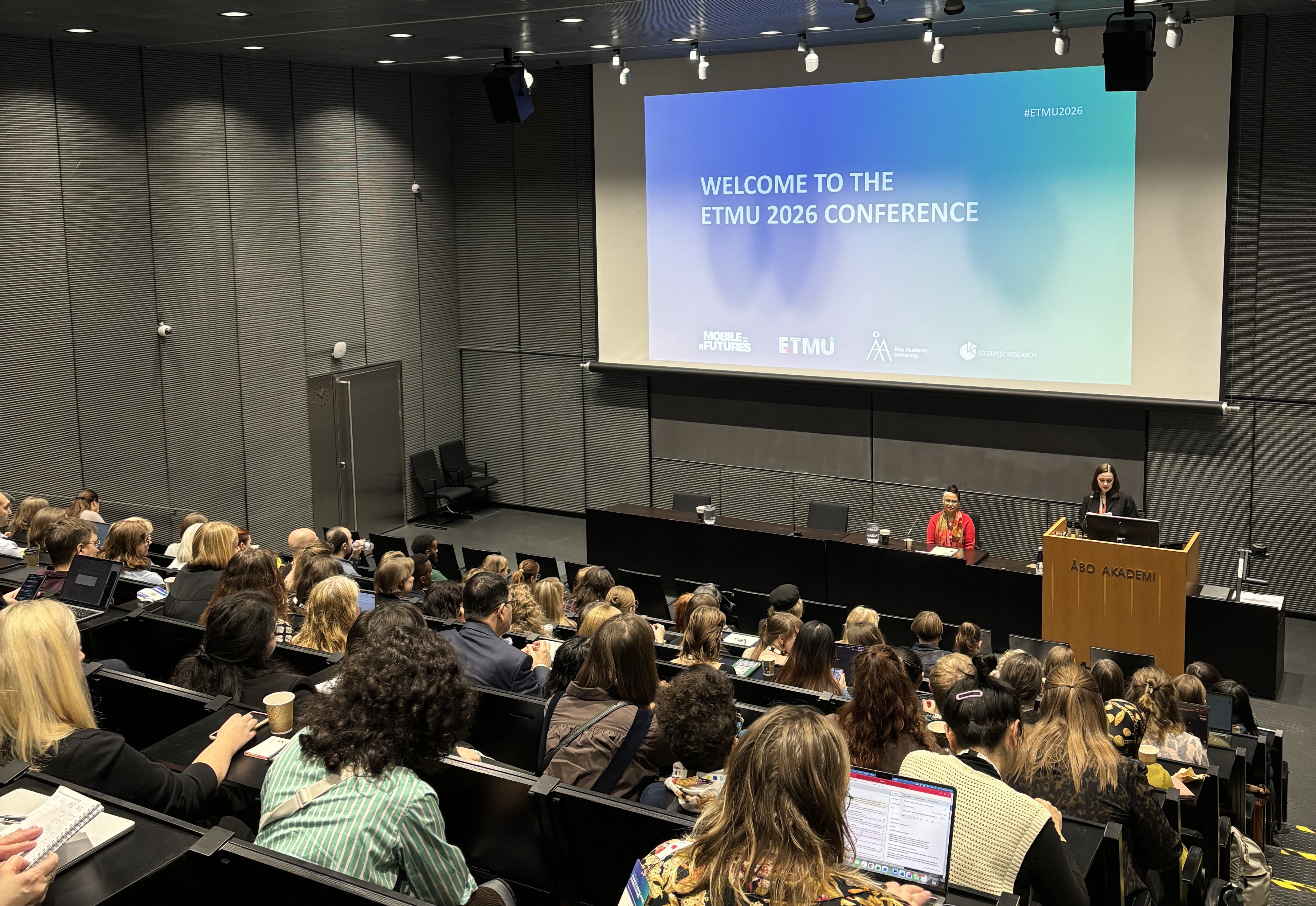
The ETMU 2026 Conference brought together around 200 researchers and professionals working on migration, integration and related topics in Turku on 4–6 November 2026. Organised by the Mobile Futures project in collaboration with the University of Turku and the Migration Institute of Finland, the conference offered three days of insightful presentations, lively discussions and opportunities to connect across research and practice.
Under the theme Towards Good Relations in Mobile Futures – The Role of Trust for Migration and Belonging, the conference explored the many dimensions of trust, mistrust and distrust in migration and integration processes. The programme included two keynote speeches, parallel sessions, workshops, a panel discussion, a book launch and the presentation of two awards.
Throughout the conference, participants contributed to a warm and welcoming atmosphere that encouraged discussions, new connections and the exchange of ideas.
Pre-conference brought doctoral researchers together
The conference began on Wednesday 4 November with a pre-conference doctoral seminar at the Migration Institute of Finland.
The seminar offered doctoral researchers an opportunity to meet fellow researchers, exchange experiences and discuss their research in a supportive environment. Feedback from participating doctoral researchers has been very positive, highlighting the importance of creating opportunities for early-career researchers to connect and learn from one another.
Two keynotes explored trust, belonging and social sustainability
The first conference day featured a thought-provoking keynote by Professor Heidi Safia Mirza, titled “Why would I come to a place that hates me for what I am” – Black and Muslim Women Decolonising Trust in New Global Times.
Mirza explored how Black and Muslim women navigate racism, migration and belonging, challenging institutional expectations of trust. An important message was that trust is something institutions must earn rather than simply expect. Her keynote also highlighted how mistrust and distrust can be understood in relation to experiences of racism, discrimination and unequal power relations.
On Friday, Shadia Rask, entrepreneur and Professor of Practice at Hanken School of Economics, delivered the second keynote, Diversity and Social Sustainability in Ageing Welfare States: Negotiations of Deservingness and Trust.
Rask discussed the tensions between ageing societies’ need for immigration and the increasingly restrictive attitudes and policies directed towards migrants. One particularly important message was that immigration is neither a problem nor a solution – it simply is. Her keynote invited participants to reflect on how immigration is discussed, who is considered deserving of belonging and what social sustainability means in increasingly diverse societies.
Research, practice and different perspectives on trust
Across the two conference days, parallel sessions and workshops explored trust and belonging from a wide range of perspectives. Topics included institutional encounters, migration policies, antiracism, education, everyday relationships and collaboration between researchers, activists and civil society organisations.
The conference also hosted the SRC Migration Researchers Meetup, convened by Ville-Pekka Sorsa, Programme Director of the SKILLS programme. The meetup brought together researchers working on migration-related topics across different SRC-funded projects, providing an opportunity to strengthen connections between research programmes, explore possibilities for collaboration and discuss the societal impact of migration research.
The programme also included the panel discussion Trust, migration and integration in Finland, which brought together Patricia Hynes, Outi Kähäri, Areen Nasser and Liisi Rwambiwa, moderated by Liselott Sundbäck.
Drawing on the newly published edited volume Trust Dilemmas – Perspectives on Trust, Migration and Integration, the panel explored trust, mistrust and distrust at different levels, from institutional relationships and everyday encounters to research settings. The discussion also addressed whether trust is always desirable or possible, and what alternatives emerge when trusting institutions or other actors involves risks.
The conference benefited from the active participation of civil society organisations, many of which contributed presentations and workshops. Their involvement was particularly appreciated at a time when many organisations are facing significant challenges.
New book on trust, migration and integration launched
One of the highlights of Thursday’s programme was the launch of the edited volume Trust Dilemmas – Perspectives on Trust, Migration and Integration, edited by Magdalena Kmak, Eveliina Lyytinen and Liselott Sundbäck.
The book brings together research exploring how trust, mistrust and distrust are shaped and negotiated in migration and integration processes in Finland. It examines trust in relation to migration law, institutions, information and everyday encounters, highlighting the importance of understanding trust as contextual, relational and dynamic.
The launch provided an opportunity to celebrate the publication and discuss its contributions to research on migration, integration and trust.
Read the open access book here.
Celebrating achievements in migration research and beyond
The conference also provided an opportunity to recognise important contributions to the field through two awards.
ETMU Award 2026
The ETMU Awards 2026 were presented by Mélodine Sommier, Chair of the ETMU Board, to University Lecturer Tobias Pötzsch and RanKids ry.
Tobias Pötzsch (University of Helsinki) was praised for his lasting and genuine commitment to build bridges between research, teaching and civil-society. In his research, he engages with issues of racism, language and belonging, multilingualism, social exclusion and migrant integration; focusing on how institutions, policies and language practices create or reproduce exclusion. His latest research project examines how social-work institutions and frontline practices can either support or constrain migrants’ participation in society. This year’s Academic ETMU Awardee is a committed scholar and a passionate and inspiring educator.
The multicultural theater association Rankids-RY has been active in Joensuu since 2000. Their original purpose was to promote inclusion and a sense of community among children who had recently arrived in Finland. Over the years, this collective has grown from a small theater club into a diverse organization that reaches out to many different groups of people, working closely with the Education services of the City of Joensuu and, in particular, its Language and Culture Department. This collective and the films and musicals they have produced have received recognition at international festivals and events, and ETMU is thrilled to put them in the spotlight once more and give further recognition to their inspiring work.
Migration Institute of Finland’s PhD Award
During the conference dinner on Thursday 5 November, Saara Pellander from the Migration Institute of Finland presented the Institute’s 2026 PhD Award to Karin Torpan for her dissertation Tenure Transitions and Residential Mobility of Migrants: Evidence from Three Nordic Welfare States.
The dissertation examines the role of housing and residential mobility in migrants’ integration, drawing on comparative longitudinal research from three Nordic welfare states. It highlights how housing trajectories, housing markets and institutional structures shape opportunities for integration and contribute to residential segregation. The award jury particularly recognised the study’s theoretical and methodological contributions, as well as its societal relevance in demonstrating the importance of housing and urban policies for integration.
Thank you for making ETMU 2026 a memorable conference!
The ETMU 2026 Conference brought together a wide range of perspectives and created opportunities for meaningful exchanges between researchers, practitioners and civil society organisations.
A warm thank you to everyone who participated, presented papers, convened sessions and organised workshops. We are especially grateful to the many civil society organisations that contributed their expertise and experiences despite the challenging circumstances they are facing.
We also extend our thanks to the ETMU Board and our collaborating partners for the excellent cooperation, and to the Strategic Research Council (SRC) for funding the conference.
Above all, thank you to everyone who contributed to the warm, welcoming and engaging atmosphere throughout these three days!
The next ETMU Conference will be organised at the University of Eastern Finland.
Further information:
Linda Karvonen, Conference secretary
Yasmin Samaletdin, Interaction coordinator